Part 1
By Christine Workman
This article was published in the December 2025 edition of Soul Search, the Journal of The Sole Society
This article was published in the Lancaster Archaeological and Historical Society’s 2024 edition of Contrebis, their online journal and concerns a John Saul who was born in Lancaster in 1718. We were lucky enough to get the author, Christine Workman’s, permission to reprint it. You can make up your own mind whether you think he is a villan or a gentleman!
Abstract
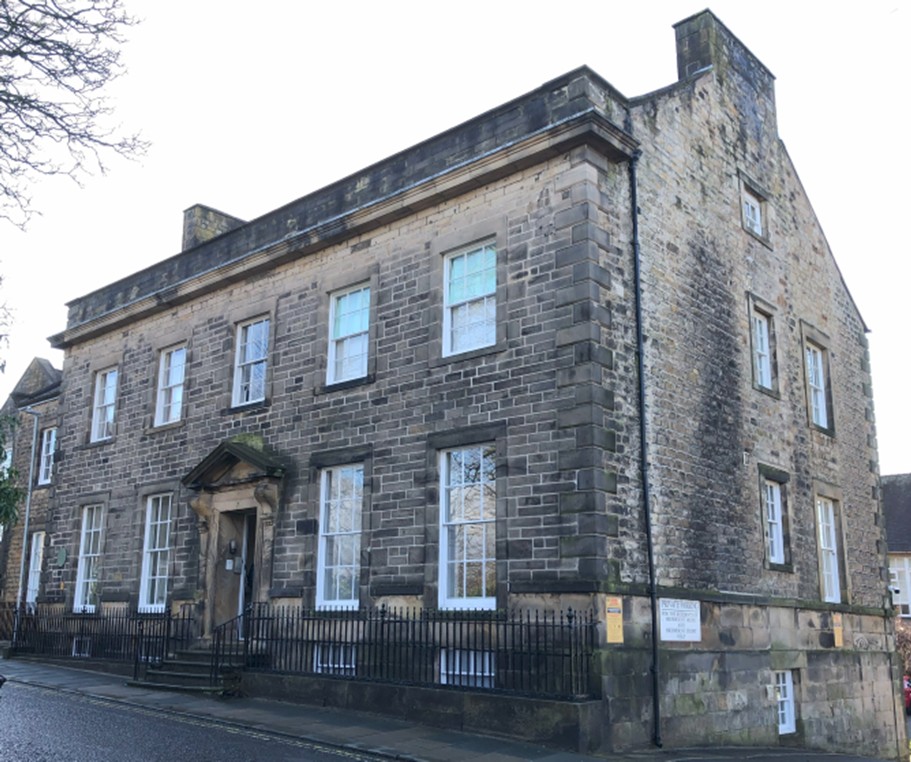
Highmount House on High Street in Lancaster is a good example of Georgian architecture and it reflects Lancaster’s wealth in the late eighteenth century. Built for Thomas Saul in 1774, the house’s history has been described by Fox.1 However, the source of Saul’s wealth was unknown. This article explains Saul’s background. It explores his dual role as a merchant’s agent in Nova Scotia and founder of Halifax, and his subsequent wealth.
The house and the man
The history of High Street House (now known as Highmount House) on High Street in Lancaster was described by Joan Fox in Contrebis in 1980. It was built on two lots of land sold to Thomas Saul in September 1770, the purchase price of £245 being paid in February 1771. The house had been completed by 1774 when Saul bought a piece of land opposite the front of his property. The house remained in the family until 1908 when it was purchased by Lancaster Corporation and became the offices of Mawson & Co, the renowned landscape architects. It is now private apartments (See image over leaf).
However, the source of Saul’s wealth to build the house was not known.
Thomas Saul came from the Furness peninsula. He was born in Kirkby Ireleth near Dalton-in-Furness in 1718 and his family were customary tenants of two estates. Therefore his father was considered a Gentleman, but two of his brothers entered trade as a mariner and shipwright and the third was a merchant. Thomas may have been educated at Kirkby Ireleth School, but his life is unknown before he appears in Nova Scotia in 1749 at the age
of 31.
Business in Nova Scotia
Nova Scotia, approximately 360 miles long and no more than 80 miles wide, is in the north-east of North America. It is a peninsula connected to New Brunswick and the mainland of Canada. It is also known as Acadia, a derivation from the native MicMaq tribe’s name for it. Nova Scotia, the Latin for New Scotland, was named by a brief Scottish settlement in the 1620s. The French set up a fur trading post on Nova Scotia in 1605 and ceded it to the British in 1610. Ownership of the territory was disputed by the British and French until the Treaty of Utrecht in 1713 when Britain gained control. A military government was imposed with troops garrisoned at Louisbourg, Cape Breton. Thomas Saul was probably the agent for William Baker, the army contractor (provisions) for these troops from around 1746. Nova Scotia was one small part of the acquisition and expansion of British territories overseas in the eighteenth century. There was the development of colonies and an expansion in trade with the West Indies and British North America, particularly the New England states. Soldiers were needed to protect British settlers from native attacks and to defend the territories from invasion. In Nova Scotia the French were seen as the main threat.
Until the 1730s armies were provisioned from local supplies and suppliers wherever the army was located. However, with an increase in the number of soldiers and worldwide locations, the British Government needed a new system of provisioning or ‘victualling’. The Government introduced contracts to supply these provisions on an annual basis. Merchants and businessmen tendered for the contracts that were usually awarded to the cheapest bid, but patronage was strong in the eighteenth century and it helped if you knew influential people. Contractors had to show business acumen because provisioning thousands of troops overseas required logistical skills and reliability.
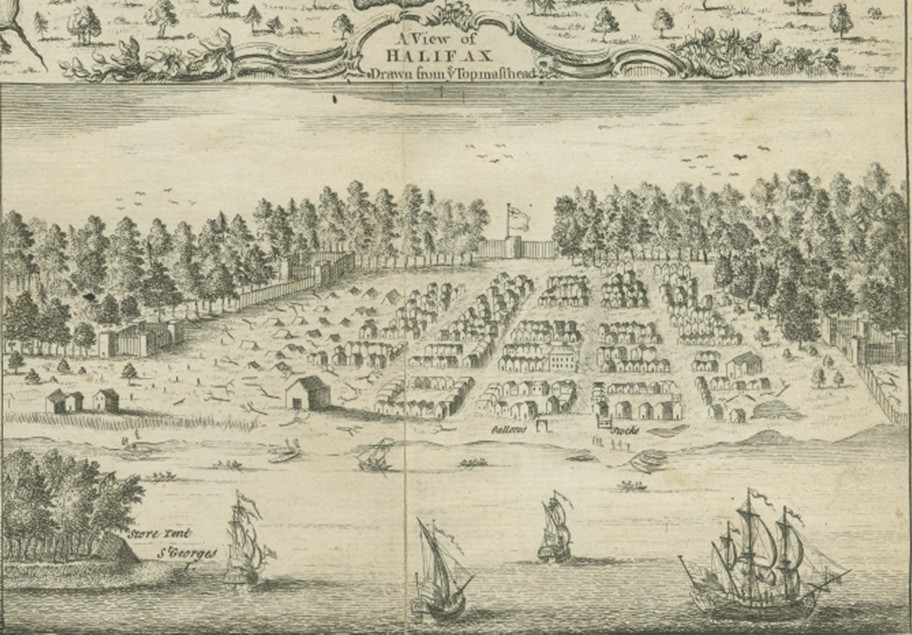
In 1749 Cape Breton was returned to France and the British troops and civilians there, including Thomas Saul, moved to Chebucto harbour where a civilian government was set up and Halifax was founded (see page 23) William Baker agreed to continue to provision the British soldiers in Nova Scotia, except for the soldiers of General Cornwallis, the first Governor of the civilian government. Cornwallis had accompanied 3000 settlers to Nova Scotia in the summer of 1749. Under a government scheme they were granted land and provided with equipment to farm and build their own homes. Before the winter set in, the settlement of Halifax was laid out, lots assigned and wooden houses and forts built, so founding the future capital of Nova Scotia.
Thomas Saul was Baker’s agent in Nova Scotia for at least 11 years. As Baker’s representative, with established channels for the supply of provisions and a ready fund of money, Saul soon became the most reliable source of food and cash in Halifax. Akins, a historian, reckoned that Thomas Saul was “the wealthiest and most enterprising merchant from 1749 to 1760”. As Baker’s agent, Saul was in control of ordering and receiving goods from Great Britain and issuing them to the troops. It is not known what his pay was, but he would have been well rewarded. Baker was contracted to provide basic provisions of bread or flour, beef/pork, pease and butter at a price of 4 to 6 pence per soldier per day. Goods were bought on long term (often annual) credit in London, and payment by the Treasury could take months and was always paid in arrears. Nevertheless, the opportunity for profit was considerable. Any surplus provisions could be sold profitably because food in British North America was expensive compared to London: for example, tea and sugar sold at twice the price. Saul was an opportunist. In 1751 he charged the Treasury for victualling full regiments of soldiers, rather than the actual number in Nova Scotia.7 The next year, Chauncy Townshend, the contractor for provisions for the settlers – all had to be imported in the early years – failed to deliver bread on time and Saul, on the Governor’s orders, bought 224,000lb of bread from British North America. This covered the immediate shortfall and for the next three months. Saul charged the Treasury nearly 80 per cent dearer than had been charged by Townshend. Baker backed Saul’s actions and an enquiry led by the future Governor, Mr Peregrine Hopson, found no wrongdoing.8 By 1752 Saul’s wealth was evident when he built one of the largest stone houses in Halifax and employed ten servants. Some of the rooms were highly furnished and ornamented with carved work and the house was described as “on a scale beyond any other private residence in the place”.9 In the same year Saul was appointed commissary of provisions for the territory, another salaried post.
Agents for contractors also had other businesses. For example, Joshua Mauger (1725–88), navy victualler in Nova Scotia, owned a rum distillery and traded as a merchant in the lucrative West Indies and American colonial trades. Mauger, Saul and other merchants in Halifax built wharves on the beach in 1750. Could Saul have been a part of this trade? With few Nova Scotian exports, some merchants filled their ships with manufactured goods from the British Isles and with British North American produce such as wheat and timber and sold them profitably in the West Indies.10 There is no evidence that Saul did this. However, Saul’s employer, William Baker, was considered to be a leading merchant in North America and Saul, as an agent, had known commercial links with the key merchants in British North America, such as Thomas Hancock of Boston, Massachusetts.
Saul’s financial acumen gained him money and influence. When coins were in short supply in the eighteenth century, Bills of Exchange were often used as currency. Those who had coin had an advantage. In September 1751 Saul was asked by Governor Cornwallis to provide coin to pay the labourers employed on public works. By 1752, he was able to lend money at interest. For example, in June he loaned £80 to George Taylor, a butcher, who mortgaged his two lots of land in Halifax. Taylor failed to pay back the loan within the two-year period and Saul took the land, renting it out at £30 per annum, and later selling it at a profit.12 By 1757 Saul was the deputy paymaster for the territory, another salaried post. That year he received £22,000 to pay the soldiers but issued less than half of it. It has been suggested that he may have temporarily borrowed some of it to fund his own trading, a common practice then, but again there is no evidence to support this.
This article will be continued in the next edition of Sole Search. n
The British expelled the Acadian (the original French) settlers from Nova Scotia in 1755 because the Acadians refused to swear the oath of allegiance to the King. Acadians were shipped to British North America ports, such as Philadelphia and Boston, with enough provisions for seven days, provided by Saul and his younger brother, George, whom Governor Lawrence appointed as commissary for the removal of the Acadians. Thomas Saul personally supervised the distribution of provisions at the three embarkation sites, on the Governor’s orders. The Acadians were dispossessed in Nova Scotia.
Acadian livestock was used to victual the armed forces and Saul and Mauger were accused of profiteering from this. At least 10,000 head of cattle were used to feed the soldiers and some cattle were sold at £4 a head. Saul had salted 4000–5000 hogs and sold them. He was said, by his clerk, to have credited the Treasury with £2000 but an enquiry in 1760 found no evidence of payment for the livestock estimated to be worth £20,000. Baker was so pleased at the savings made by using the livestock that he gave Saul an extra £300.15 Baker’s contract was renewed to supply 12,000 soldiers in British North America with provisions and pay in March 1756. With Britain at war between 1756 and 1763, the Treasury made a hasty decision to accept Baker’s proposal of 6 pence a day, rather than advertise to get a cheaper bid. Baker and Christopher Kilby, his partner, would have made substantial profits16. That summer Saul provisioned 17 battalions of soldiers (17,000 men) in Nova Scotia and British North America17. Even for goods “unfit to eat”, as in 1757, Baker’s company were still paid £121,714 for them.
The war also brought other financial opportunities for Saul. British shipping was being attacked by the French therefore privateers (armed ships) were authorised by the British government to protect British shipping and capture any French ships. Saul went into partnership with William Ball, another Halifax merchant, in the schooner Monckton, which captured a French brig in Louisbourg harbour in 1758. As part owner Saul would have profited from the sale of the brig and its cargo.19 This could be very profitable: a French ship captured in 1756 was valued at £8000 with a cargo of sugar at £10,000.20 Saul also acted as an agent for ‘prizes’, as the captured ships were called. He would get commission on the sale of the prize and its cargo. That work continued after he left Nova Scotia in 1761, as his London attorney, on his behalf, dealt with payment of the profits to the crew involved in
The capture.
Saul acted for at least seven prize ships captured in 1756 and 1758. Thomas Saul enjoyed the support of successive Governors of Nova Scotia. This protected him when his actions were questioned, as with the bread incident in 1752. Five years later, an anonymous letter to Lord Loudoun, then Commander-in-Chief of British Forces in North America, accused Governor Lawrence of diverting thousands of pounds of public money to his own use. It also stated that Lawrence was under obligation to Thomas Saul, then described as a “villan consumate in iniquity”. Saul was accused of giving the soldiers short provisions. No further action was taken by the British government.
Merchants in Halifax complained about Thomas Saul and Governor Lawrence. Lawrence wanted a prize ship, The Equity, which had been taken by the British naval captain John Rous, and he used his influence to force a judge to decide in his favour. Thomas Saul was the agent who seized the ship and its cargo and sold it for Lawrence. No action was taken. Lawrence governed with a small Council of advisers who supported him. He had refused to call an Assembly because this would weaken his control. However, complaints, as above, led the Board of Trade to force his hand and an Assembly was called in October 1758. Lawrence had to accept this, but he strengthened his Council by appointing Thomas Saul in 1759, along with three other Lawrence supporters.
Baker and his partners pulled out of the victualling contract in 1760. The new contract was awarded to Sir George Colebrooke. It was 20 per cent cheaper than Baker’s, indicating perhaps how much profit Baker had made. So why did he give it up? There were several reasons. Firstly, there was a cessation in hostilities in the war and this reduced the potential profit. Secondly, the death of George II led to political change and less patronage. Thirdly, Baker, who was already a Director in the East India Company and a Deputy Director of the Hudson Bay Company became Director of the latter in 1760. It was time to move on.
Thomas Saul also left Nova Scotia in 1760/61. He did not sell his property consisting of a house, storehouses and a wharf, in Halifax which may indicate that he continued to trade with Nova Scotia.
His will of 1779 mentioned “goods at Halifax” as well as land and property, which reinforces this idea. Saul also continued to influence Nova Scotian politics from England. In 1762 he obtained a commission for Richard Bulkeley, a prominent Halifax politician, to help him achieve further appointment in the Nova Scotian government.
Life in Lancaster
There is a gap in Saul’s history between 1761 and 1768. Did he stay in London or did he return to north-west England? Why might he come to Lancaster? George Saul, his brother, had moved there by 1769 and another brother, William, a sea captain, also had links to the town.27 Perhaps they encouraged Thomas Saul to settle there. He became a Freeman of Lancaster in October 1763, and that gave him the right to trade in the town and through the port.28 Lancaster, the fourth most important transatlantic port, presented trading opportunities for a gentleman with means.
On the death of his father, Saul inherited the two customary estates at Ireleth and property at Arnside in 1768.29 This would have increased his standing as a gentleman and perhaps made him an eligible match. It might also have put pressure on him, at the age of 50, to produce an heir or two. Within three months of his father’s death he married an heiress, Jane Hadock, who at the age of 22 was years younger than him. She produced four children. They rented a property on Castle Hill, suitable to his status as a gentleman until their new house on High Street was built. Saul died in 1779.31 His wealth is reflected in the ownership of land at Kirkby Ireleth, Arnside and the house on High Street, as well as all his property in Halifax, Nova Scotia. He sold the latter a few months before he died, and in a codicil to his will, he left the proceeds, value unstated, to his children. Financially he had settled £8,500, invested in East India stock at three and a half per cent, on his wife in lieu of dower (a widow’s share for life of her husband’s estate), giving her an annual income of £250. He left £2400, also invested in the East India stock, to be divided between his children when they reached the age of 21. The value of his personal effects is not known, but they included a gold watch and diamond ring. He requested that his four children be brought up “consistent with their fortunes and status in life”. The invested money alone is equivalent to £1.5 million in 2024.
Thomas Saul was a private person, his early and later life still shrouded in mystery. In the British Empire he appeared in written records as a signature or a mention of his name, yet his position gave him power and influence over the people of Nova Scotia for a decade or more. It also ensured that he was a wealthy man, able to build a house in Lancaster befitting his status as a gentleman.
Lancaster’s Georgian wealth is often associated with the West Indies trade and the enslavement and exploitation of Africans on the plantations. Saul’s neighbour John Rawlinson, a West Indies merchant who built Numbers 2–6 High Street with the profits of the trade, illustrates this. However, Thomas Saul shows that there were other ways to earn a living and become wealthy in Georgian times.
Author profile
Christine Workman is a retired History and Humanities teacher. Her interests focus on the social and economic development of north-west England. Recently she has contributed articles to Global Link’s Documenting Dissent and Migration Stories NW websites.
This reproduction of this paper is with the permission of Christine Workman and Lancaster Archaeological and Historical Society.