Part 2
By Christine Workman
This article was published in the April 2026 edition of Soul Search, the Journal of The Sole Society.
We continue the article about Thomas Saul of Lancaster which was originally published in the Lancaster Archaeological and Historical Society’s 2024 edition of Contrebis, their online journal. We left him in Halifax, Nova Scotia, as a business man and money lender.
The British expelled the Acadian (the original French) settlers from Nova Scotia in 1755 because the Acadians refused to swear the oath of allegiance to the King. Acadians were shipped to British North America ports, such as Philadelphia and Boston, with enough provisions for seven days, provided by Saul and his younger brother, George, whom Governor Lawrence appointed as commissary for the removal of the Acadians. Thomas Saul personally supervised the distribution of provisions at the three embarkation sites, on the Governor’s orders. The Acadians were dispossessed in Nova Scotia.
Acadian livestock was used to victual the armed forces and Saul and Mauger were accused of profiteering from this. At least 10,000 head of cattle were used to feed the soldiers and some cattle were sold at £4 a head. Saul had salted 4000–5000 hogs and sold them. He was said, by his clerk, to have credited the Treasury with £2000 but an enquiry in 1760 found no evidence of payment for the livestock estimated to be worth £20,000. Baker was so pleased at the savings made by using the livestock that he gave Saul an extra £300.15 Baker’s contract was renewed to supply 12,000 soldiers in British North America with provisions and pay in March 1756. With Britain at war between 1756 and 1763, the Treasury made a hasty decision to accept Baker’s proposal of 6 pence a day, rather than advertise to get a cheaper bid. Baker and Christopher Kilby, his partner, would have made substantial profits16. That summer Saul provisioned 17 battalions of soldiers (17,000 men) in Nova Scotia and British North America17. Even for goods “unfit to eat”, as in 1757, Baker’s company were still paid £121,714 for them.
The war also brought other financial opportunities for Saul. British shipping was being attacked by the French therefore privateers (armed ships) were authorised by the British government to protect British shipping and capture any French ships. Saul went into partnership with William Ball, another Halifax merchant, in the schooner Monckton, which captured a French brig in Louisbourg harbour in 1758. As part owner Saul would have profited from the sale of the brig and its cargo.19 This could be very profitable: a French ship captured in 1756 was valued at £8000 with a cargo of sugar at £10,000.20 Saul also acted as an agent for ‘prizes’, as the captured ships were called. He would get commission on the sale of the prize and its cargo. That work continued after he left Nova Scotia in 1761, as his London attorney, on his behalf, dealt with payment of the profits to the crew involved in
The capture.
Saul acted for at least seven prize ships captured in 1756 and 1758. Thomas Saul enjoyed the support of successive Governors of Nova Scotia. This protected him when his actions were questioned, as with the bread incident in 1752. Five years later, an anonymous letter to Lord Loudoun, then Commander-in-Chief of British Forces in North America, accused Governor Lawrence of diverting thousands of pounds of public money to his own use. It also stated that Lawrence was under obligation to Thomas Saul, then described as a “villain consummate in iniquity”. Saul was accused of giving the soldiers short provisions. No further action was taken by the British government.
Merchants in Halifax complained about Thomas Saul and Governor Lawrence. Lawrence wanted a prize ship, The Equity, which had been taken by the British naval captain John Rous, and he used his influence to force a judge to decide in his favour. Thomas Saul was the agent who seized the ship and its cargo and sold it for Lawrence. No action was taken. Lawrence governed with a small Council of advisers who supported him. He had refused to call an Assembly because this would weaken his control. However, complaints, as above, led the Board of Trade to force his hand and an Assembly was called in October 1758. Lawrence had to accept this, but he strengthened his Council by appointing Thomas Saul in 1759, along with three other Lawrence supporters.
Baker and his partners pulled out of the victualling contract in 1760. The new contract was awarded to Sir George Colebrooke. It was 20 per cent cheaper than Baker’s, indicating perhaps how much profit Baker had made. So why did he give it up? There were several reasons. Firstly, there was a cessation in hostilities in the war and this reduced the potential profit. Secondly, the death of George II led to political change and less patronage. Thirdly, Baker, who was already a Director in the East India Company and a Deputy Director of the Hudson Bay Company became Director of the latter in 1760. It was time to move on.
Thomas Saul also left Nova Scotia in 1760/61. He did not sell his property consisting of a house, storehouses and a wharf, in Halifax which may indicate that he continued to trade with Nova Scotia.
His will of 1779 mentioned “goods at Halifax” as well as land and property, which reinforces this idea. Saul also continued to influence Nova Scotian politics from England. In 1762 he obtained a commission for Richard Bulkeley, a prominent Halifax politician, to help him achieve further appointment in the Nova Scotian government.
Life in Lancaster
There is a gap in Saul’s history between 1761 and 1768. Did he stay in London or did he return to north-west England? Why might he come to Lancaster? George Saul, his brother, had moved there by 1769 and another brother, William, a sea captain, also had links to the town. Perhaps they encouraged Thomas Saul to settle there. He became a Freeman of Lancaster in October 1763, and that gave him the right to trade in the town and through the port. Lancaster, the fourth most important transatlantic port, presented trading opportunities for a gentleman with means.
On the death of his father, Saul inherited the two customary estates at Ireleth and property at Arnside in 1768. This would have increased his standing as a gentleman and perhaps made him an eligible match. It might also have put pressure on him, at the age of 50, to produce an heir or two. Within three months of his father’s death he married an heiress, Jane Hadock, who at the age of 22 was years younger than him. She produced four children. They rented a property on Castle Hill, suitable to his status as a gentleman until their new house on High Street was built. Saul died in 1779.31 His wealth is reflected in the ownership of land at Kirkby Ireleth, Arnside and the house on High Street, as well as all his property in Halifax, Nova Scotia. He sold the latter a few months before he died, and in a codicil to his will, he left the proceeds, value unstated, to his children. Financially he had settled £8,500, invested in East India stock at three and a half per cent, on his wife in lieu of dower (a widow’s share for life of her husband’s estate), giving her an annual income of £250. He left £2400, also invested in the East India stock, to be divided between his children when they reached the age of 21. The value of his personal effects is not known, but they included a gold watch and diamond ring. He requested that his four children be brought up “consistent with their fortunes and status in life”. The invested money alone is equivalent to £1.5 million in 2024.
Thomas Saul was a private person, his early and later life still shrouded in mystery. In the British Empire he appeared in written records as a signature or a mention of his name, yet his position gave him power and influence over the people of Nova Scotia for a decade or more. It also ensured that he was a wealthy man, able to build a house in Lancaster befitting his status as a gentleman.
Lancaster’s Georgian wealth is often associated with the West Indies trade and the enslavement and exploitation of Africans on the plantations. Saul’s neighbour John Rawlinson, a West Indies merchant who built Numbers 2–6 High Street with the profits of the trade, illustrates this. However, Thomas Saul shows that there were other ways to earn a living and become wealthy in Georgian times.
Author profile
Christine Workman is a retired History and Humanities teacher. Her interests focus on the social and economic development of north-west England. Recently she has contributed articles to Global Link’s Documenting Dissent and Migration Stories NW websites.
This reproduction of this paper is with the permission of Christine Workman and Lancaster Archaeological and Historical Society. For further reproductions of this paper please contact the journal’s Editor, Dr Gordon Clark
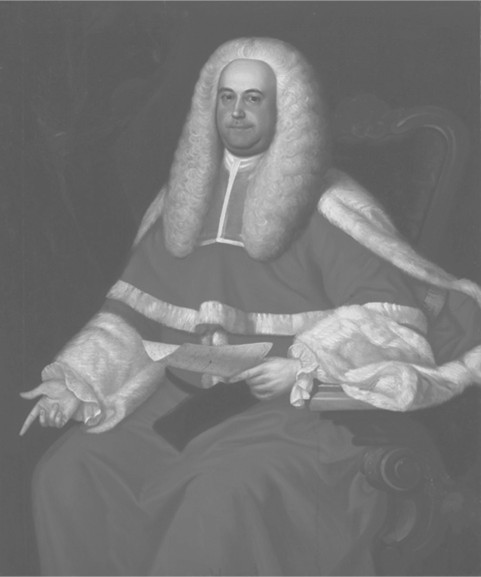
Chief Justice for the Nova Scotia Supreme Court from 1754 to 1776 during Thomas Saul’s time in Halifax.