
By Maureen Storey
This article was published in the August 2026 edition of Soul Search, the Journal of The Sole Society
Roches Point Lighthouse sits at the entrance to Cork, Ireland’s largest natural harbour, and was considered to be one of the major Irish lighthouses of the nineteenth century. The first lighthouse was built there in 1817 but by 1832 it was felt that it wasn’t tall enough to be well seen by vessels approaching the harbour so it was dismantled for use elsewhere and was replaced with a new taller one.
Although Roches Point was considered an important light, until 1861 it was manned by a single keeper, unlike many other Irish lighthouses. It was the keeper’s job to tend the light during the hours of darkness (which lasted up to 14 hours in the winter), to clean the lenses and to make any necessary repairs. The keepers of onshore lighthouses lived on site with their families, often in remote and difficult to access locations and were expected to work six days a week throughout the year.
In the nineteenth-century the light of lighthouses came from combustion with the fuel commonly being coal, oil or candles, but life for the keeper was hard, whichever type of light source was used. The lamp had to be relit every night and then kept as bright as possible. This involved refuelling the lamp as necessary, adjusting wicks to the optimal length and polishing the lenses to keep them clear of soot. But with even the most conscientious keeper weather conditions often meant that the light was hard to see from ships out at sea. The following extract is from an inspection committee report on Roches Point Lighthouse in 1859, when the keeper was Bradley Sole.
The illuminating apparatus is catoptric, fixed, 9 red chimneys to seaward, 8 white towards harbour. There is only one keeper. He has 12 children. Receives £64 a year. He repeatedly asked for an assistant. There are no signals. He breaks a chimney every night. There is no water cistern. The keeper complains of the hardship of having stone floors in his dwelling house. Everything in this lighthouse appears to be in good order, all the reflectors were covered in brown paper. The accommodation is good for a small family. The keeper informed us that on one occasion a duck got into the lantern through the cowl, and fluttering around broke nearly all the chimneys and put out the light.
As there are great complaints of this light house not showing well beyond a short distance to seaward, we think it is advisable to state that we saw no symptoms of neglect anywhere. If, however, lights require careful and constant attention to prevent them burning dull, we deem it probable that where there is only one keeper considerable intervals will elapse without any attention being paid to the lights. It is not possible that in a long winter night of 14 hours, one keeper can keep his attention constantly alive. He will, we believe, inevitably go to sleep.
The chimneys referred to in this report were the glass cylinders that surrounded the flame of the oil lamp. Despite the apparent recommendation that the keeper needed an assistant, one wasn’t forthcoming while Bradley worked there, however a second keeper was appointed in 1864.
So who was Bradley Sole?
He was born in Deal, KEN, on 20 Nov 1812 and was the eldest of the five children of Eastes and Mary Finnis (nee Roberts) Sole. His Sole family were long time residents of Deal and records of them there go back to at least the sixteenth century. Bradley’s grandfather (another Bradley) was a boat-builder in the town but in the early nineteenth century boat-building was in decline in Deal and both his sons left the area – his son Bradley went to the shipyards of Southampton, while Eastes took his wife and children to live in Ireland. Eastes died in Dublin in 1824 leaving Mary Finnis alone to bring up the family.
The next record we have for Bradley is on 12 May 1836 when he entered the service of the Commissioners of Irish Lights as a keeper at the new lighthouses in Sligo harbour. Then in 1837 he married Anne Meredith, the daughter of the local sub-inspector of constabulary. From Sligo, Bradley and his ever-growing family moved first to St John’s Point lighthouse (Co Donegal), then to Balbriggan (Co Dublin) before arriving at Roches Point in about 1845, a position he held for almost 20 years.
In 1864 Bradley was transferred to Valentia (Valentia Island, Co Kerry), the most westerly harbour light in Ireland. When he first took up the post it was another single-man light but in 1866 the Commissioners appointed a Female Assistant Keeper in the form of his 17-year-old daughter Elizabeth. Bradley’s last appointment was a return to Balbriggan in 1872.
By 1880 Bradley had retired to Donaghadee in Co Down, where he died 1883 of general debility and dropsy.
Bradley was followed into the lighthouse service by his son John Bradley, who was born at Roches Point in 1852. John became a lighthouseman in January 1873 and was invalided out of the service in 1910, after a career in which he served in at least 12 stations.
Sources; Sole Society records and https://irishlighthouses.blogspot.com/
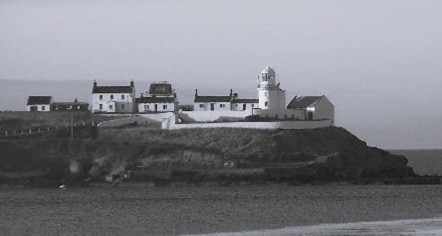
Reproduced under Creative Licence