
By Dorothy Saul-Pooley
This article was published in the August 2026 edition of Soul Search, the Journal of The Sole Society
Having read the fascinating piece by Carol Saul in the December 2025 issue of Sole Society, I would like to add a few more details to the story of John Bycroft Saul, who was my grandfather.
What follows is based on some notes written by my uncle, John Julian Bycroft Saul, who wrote them and sent them to his siblings in 2001.
John Bycroft Saul was born on 4th October 1883 as the second son of George Frederick Saul and Clara Saul (nee Balch), who lived at Woodmancote, High Street, Lymington. He had three brothers, George, Alec, and Roy. Alec went to South Africa and practised as a dentist, as did Roy. There were two sisters, Winifred (married Lionel Smith who was killed in submarine service in the 1939-1945 war) and Dorothy who married Stafford Tidy.
As stated in Carol’s article, George Frederick Saul, a much-respected Ironmonger, and District Councillor in Lymington died on 18th April 1910 aged fifty-eight and is buried in Lymington Churchyard.
John attended Reading School, where he played football in the school team of 1899-1900. In 1907, he qualified as a solicitor and although there is no record of where he commenced practice, there are press reports of him having been a member of the Ilfracombe Golf Club in North Devon, where he played off a handicap of 9 and won various club competitions, including mixed ones.
He also took part in amateur dramatics and performed at the Alexandra Theatre in Ilfracombe on 30th November 1909, in the part of Dr Candy in “the New Boy”. This performance won considerable approval both of the audience and the local reporter who wrote the review in the local paper.
At the outbreak of the first war in 1914, John was a member of the HAC and joined up as a private in the Kings Own Yorkshire Light Infantry, being commissioned in early 1916. He won the Military cross and was mentioned twice in despatches.
He served in Afghanistan until 1921 with the rank of Major and during his military service was seconded to the Machine Gun Corps. A photograph exists showing him as commander of the No 6 (res) company, no 2 (res) Battalion, Machine Gun Corps taken in Grantham in Lincolnshire on June 1918, although I cannot locate it at present. He was gassed in the trenches at some point leaving him severely wounded and the after effects haunted him for the rest of his short life.
Following demobilisation, John returned to practising as a Solicitor in partnership with Humphrey Gregson and later joined Richard Golding in Alexandra Street, Southend-on-Sea, in the firm of Gregson, Saul & Golding.
He married his first wife and the marriage took place in the parish church of St Martins in the Field, London on 16th September 1920. The records show that when John Bycroft Saul married Emily Elsie Randall, his age is given as 36 years, a bachelor and solicitor. Residence at that time was the Golden Cross Hotel, Strand his father being George Frederick Saul, an ironmonger. The bride was 25 years of age, a spinster resident at 5 The Common, Woolwich, her father was Arthur Randall, a retired Army Warrant Officer. The witnesses were stated to be Clara Saul (presumably John’s mother) and Capt R Saul (most likely John’s youngest brother, Edward Royston, shortened to “Roy”).
Sadly Emily died young, her death certificate records that she died on 1st June 1924, aged just 29 years, at Cranbrook, Grand Parade, Leigh on Sea the wife of John Bycroft Saul, a solicitor. She died of Pulmonary Arthritis and Haemoptysis (the latter she had suffered from for 3 years).
Emily contracted what was often called TB in the early 1920s and this illness brought John into contact with the woman who was to become his second wife, the daughter of his wife’s Doctor, Dr William Douglas Watson.
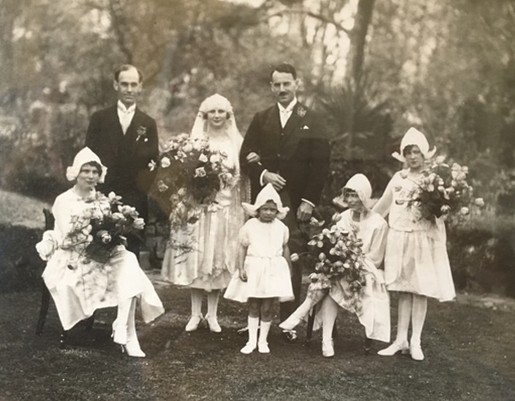
John was a keen tennis player and often played with Doctor Watson. My grandmother told me that she fell in love with John when she saw him in his tennis whites beating her father! Another apocryphal story involved him buying a cabbage. Whatever the truth (my grandmother was an imaginative and sensuous artist!) John married Juliana Margaret Watson at St Clement’s Church, Leigh-on-Sea on 14th April 1926 and moved into Spin Baldak, (named after an Afghan Fort) in Theobalds Road, Leigh-on-Sea, where their first son, John Julian Bycroft was born on 31st May 1927.
The family moved to Rochford where Jennifer was born on 9th October 1930, and Philip (my father) was born on 19th February 1933. During the 1930s, John’s hobbies included sailing (he had a 7-ton yawl named Coot – his father had had a similarly named boat at Lymington) and rough shooting, as well as golf.
My father also had these hobbies and when we lived in Thorpe Bay in the 1960s, Philip Saul was secretary of the local yacht club. He also shot at Bisley, competing in a team called the English Eight from 1956-1992 (and I have continued the tradition, gaining my yachting qualifications as well as shooting in my university second team in the 1970s).
The second war in 1939 and enforced evacuation of the majority of the population from Southend (which reduced from 150,000 to 10,000 in six months) led to the closing of the successful legal practice and the family having to move from their large rural home to a small flat in Buckinghamshire where John took a job as a transport manager with a local firm in High Wycombe. This was poorly paid in comparison to the £2500 pa he had been earning as a solicitor before the war.
In 1942 he was approached by George Jeudwine whose legal practice in Lincolnshire had been severely curtailed by his call up for active service and John moved up to Heckington in Lincolnshire where he took over the practice until his death on 8th January 1946. Despite Mr Jeudwine appealing for early release from armed services on account of John Saul’s failing health, the War Office was unsympathetic, and John died whilst still working, aged sixty-two.
John’s son, John Julian, had recently joined the Army and was based at Malvern, Worcesterhire, No 1 Training Battalion, Royal Engineers at the time of his father’s death. Jennifer and Philip were still at school. John’s memorial service was held at St Denys Church, Sleaford and he was cremated at Nottingham crematorium on 14th January 1946.
After John’s death, his widow, Juliana (known as Tooley) returned to Leigh-on-Sea, living next door to her own mother. She died on 2nd March 1987, and her ashes were spread by her children under one of the cedar trees in Leigh House gardens (now a Council owned public space) under which she had played as a child.
My father, Philip Bycroft Saul, became a solicitor and after several different employers started his own firm in the west end of London, which he ran until he retired in 1998 because of ill-health.
(I also followed in the footsteps of my father and grandfather, qualifying as a solicitor in 1982, but have then taken other directions and am now a Consultant Editor for a family publishing company and have written, edited, and proof read more than forty training books and manuals for pilots.)