By Peregrine Solly
This article was published in the August 2026 edition of Soul Search, the Journal of The Sole Society
My 5th great grandfather, William Henry Solly, was the Collector of Customs at Sandwich in the second half of the eighteenth century, as well as being the local solicitor. Among his papers is a licence for a shipment of rice from Carolina to Sandwich in 1763. As most of his papers are about local legal matters, this one is interesting as it tells us a little about his role as the Collector of customs, and because it reveals something of the risks and rewards of trade with Britain’s American colonies.
That Sandwich merited its own Collector of Customs in the eighteenth century is itself quite interesting. As one of the Cinque Ports it had played a significant part in our island history; but by 1763 the River Stour had silted up, and it been closed to most shipping for over a hundred years. However, Sandwich was still an important commercial centre and, as this licence shows, was involved with trade with the Colonies. The licence is the permission for a Sandwich merchant, William Slaughter, to ship a cargo of rice from Charles Town in Carolina to Lisbon in Portugal. Rice from the American South had become one of the most sought-after commodities in the eighteenth century. Nicknamed “Carolina Gold” because of its colour and its value, it was of excellent quality, and highly valuable and had transformed the economy of Carolina. Classed as an “Enumerated Commodity” along with other high-value products from the Colonies (such cotton, sugar, furs and indigo) rice originally had to be landed in an English Port even if it was destined for another country, increasing the cost and adding delay much to the irritation of the merchants involved. The 1730 Rice Act lifted this restriction, permitting rice from America to be shipped directly to a port “southward of Cape Finisterre” such as Lisbon.
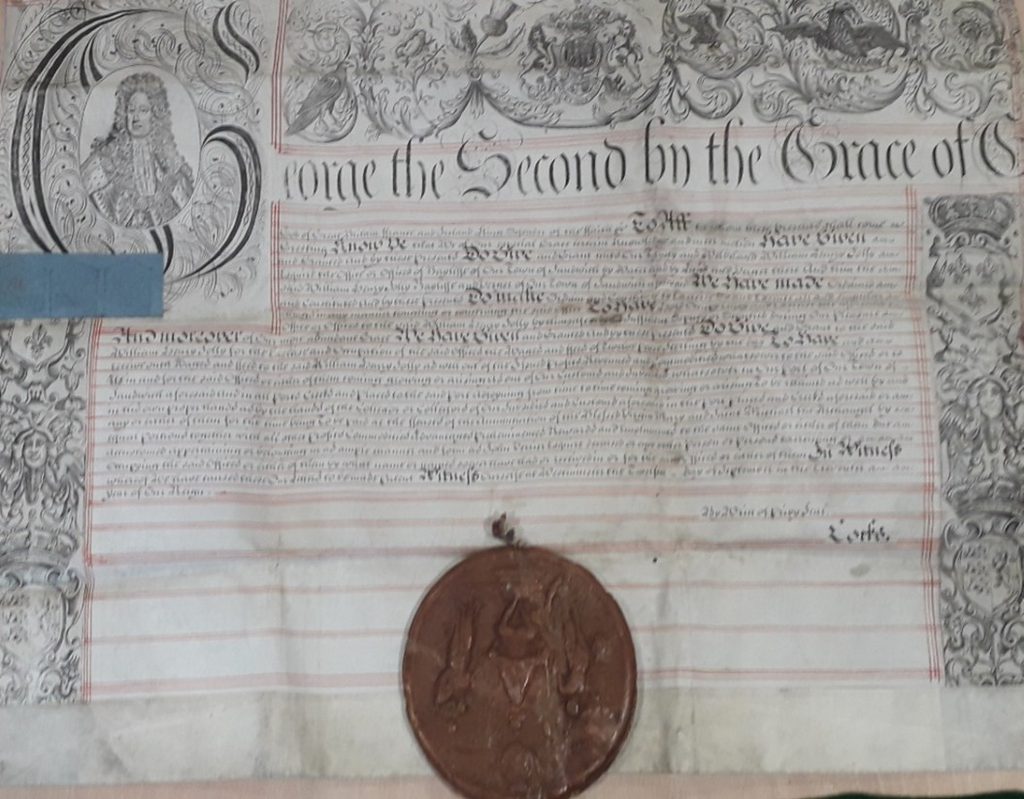
Although, the Rice Act had made things easier for the merchants, the Crown still wanted to maintain control over trade with its possessions which explains William Henry Solly’s involvement. As the Collector at Sandwich, he was required to ensure that such cargoes were licensed and underpinned by a bond which would have been forfeit if the rice went astray. In this case the bond was for £2,000 (roughly half a million pounds today) which gives us some idea of the scale of the enterprise. On top of the bond, William Slaughter would have had to buy a vessel, to fit it out it for a six-month voyage, hire a master and crew, and still have enough money to buy the cargo of rice in Charleston. While the costs of the venture were considerable, fortunately so were the rewards. A cargo such as this, 400 barrels of rice with a weight of almost 2,000 lbs, would have netted at least £700,000 in today’s money.
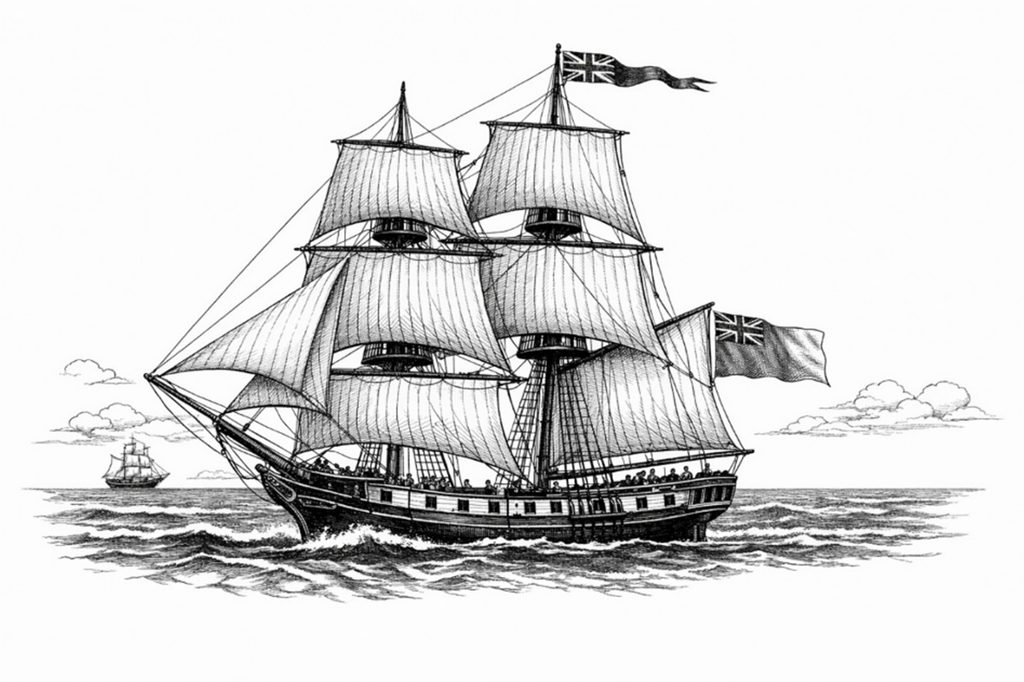
The risks of course were also high. In 1763 the Seven Years War was just ending making trade with the Americas somewhat easier; although there were fewer enemy ships, the “William and Susannah” will still have had to avoid pirates, privateers, and the other constant hazard, the Atlantic weather. Insurance for a voyage such as this would have been particularly high during wartime, so, it is interesting to realise that that William Slaughter raised his bond for the shipment in January 1763, a month before the war ended. He had clearly started preparing for the venture many months earlier, as he acquired a boat in 1762. This was a 60-ton, French brigantine (a square-rigged two-masted vessel) which may well have been captured in the War which he named the “William and Susannah” after his first wife who had died that year.
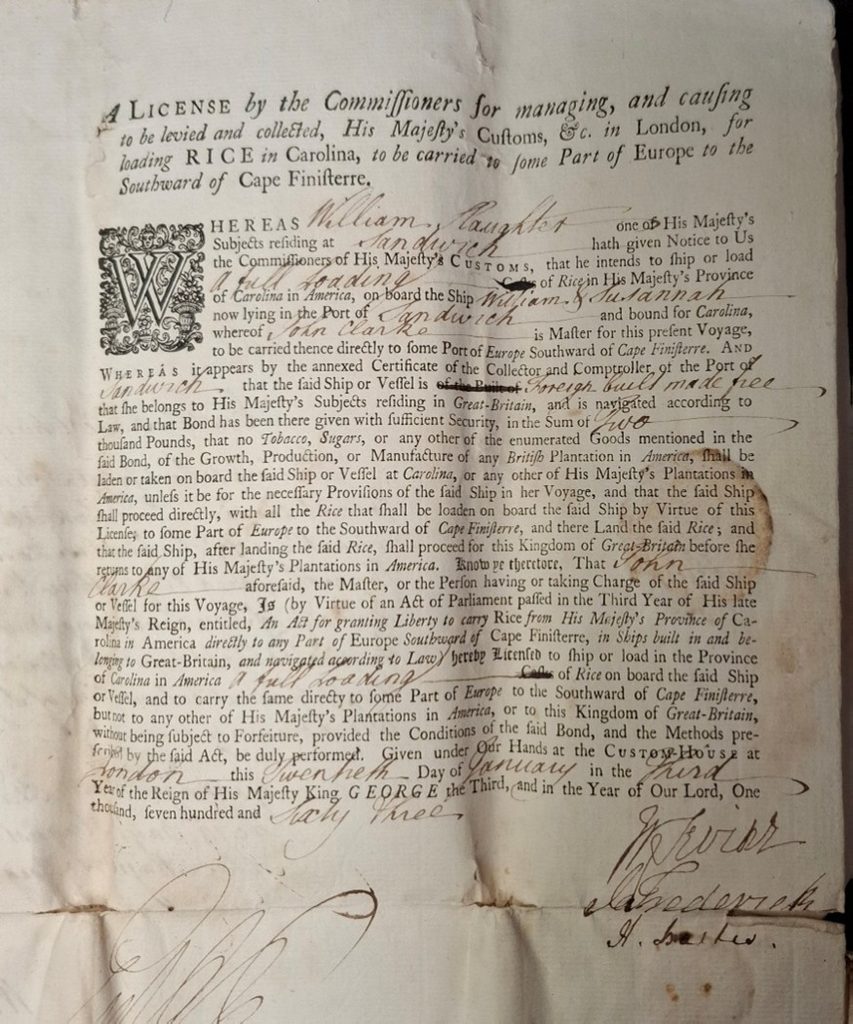
Sadly, I have yet to find anything in William Henry Solly’s papers to tell me how successful this venture was. The licence confirms that the rice was landed in Lisbon, but there is nothing to say when or where it was sold or whether it made a profit. However, we do know that the “William and Susannah” survived, as she is recorded in the Lloyds Register of shipping for the following year as having made a voyage to Newfoundland, but sailing from Devon with a different master and owner. William Slaughter also appears to have prospered as he was buried in St Clements in Sandwich in 1780 aged 52 with a substantial tombstone. So, it would appear that at the very least this foray into the Atlantic rice trade was not a disaster.