By Maureen Storey
This article was published in the April 2026 edition of Soul Search, the Journal of The Sole Society
Martha Babson Lane and Moses Soule were married on 9 Jan 1794 in Freeport, Maine, USA. Martha was a descendant of the Lane family that had settled in the Freeport area as early as the 1650s, while the ancestry of Moses, son of Moses Soule and Nancy Ann Hughes, has been traced back to George Soule, who emigrated to America aboard the Mayflower in 1620. Moses is well documented with the following description is taken from the Soule Pamphlet by C. E. Banks (the description is attributed to an unnamed descendant):
Physically he stood a little short of six feet; erect, well-proportioned and powerful. He was a handsome man with a countenance as firm as Plymouth Rock. He was a caulker by trade and was sought, far and near, to lead the crew on account of his skill. His word was his bond. His religious opinions were decided, and allowed no wavering of faith. For many years he was deacon of the Congregational Church and as such, I suppose, to the end of his life, excused from service, for the last few years, on account of infirmities and distance. He regarded the Sabbath, and made it to be a matter of conscience to be early at the place of worship on that day, with such of his family as could properly attend.
In addition to his work as a deacon of the church and as a cauker, Moses also had a farm in the Freeport area.
Moses and Martha had 11 children, three of whom died in childhood. Of their four sons, the oldest Charles became a teacher, was ordained as minister, and was known for writing prose and poetry. Gideon was a renowned educationalist and became principal of Phillips Exeter College, where he introduced several educational reforms during his 50-year association with the institution. Moses combined farming with a long teaching career. John, the youngest of the four also began as a teacher and became a minister, but he branched out into journalism – he is believed by some to have been responsible for coining the phrase ‘Go West young man’.
As well as caring for her children and helping with the family farm, Martha was an expert needlewoman and two of her embroidered quilts are now part of the Smithsonian Collection.. The one shown here is believed to have been made in about 1792 and was donated by Mrs Kendall B Melcher, whose husband was the great great grandson of Moses and Martha. The note that accompanied the donation said Martha had ‘spun and dyed the worsted fabric and designed the pattern embroidered on it’. The donor also went on to say that ‘the mate of this quilt’ had been donated to the museum in 1925.
The quilt is described as having a 38-inch central panel, embroidered in indigo-dyed wool, which is surrounded by a border consisting of 8-inch printed cotton squares and triangles with a crewel embroidered outer border. The base fabrics of the embroidered sections and their linings are cotton and linen/cotton and there is a thin layer of carded cotton between them. It is thought that the central square may have been cut from a larger piece of embroidery. The embroidery stitches used in the quilt include stem, cross, herringbone, buttonhole, Roumanian, running and couching.
Both Moses and Martha died in Freeport, Cumberland, Maine, Martha on 20 Dec 1837, aged 60, and Moses on 4 Oct 1851, aged 81 and they are buried in the Lane cemetery in Freeport.
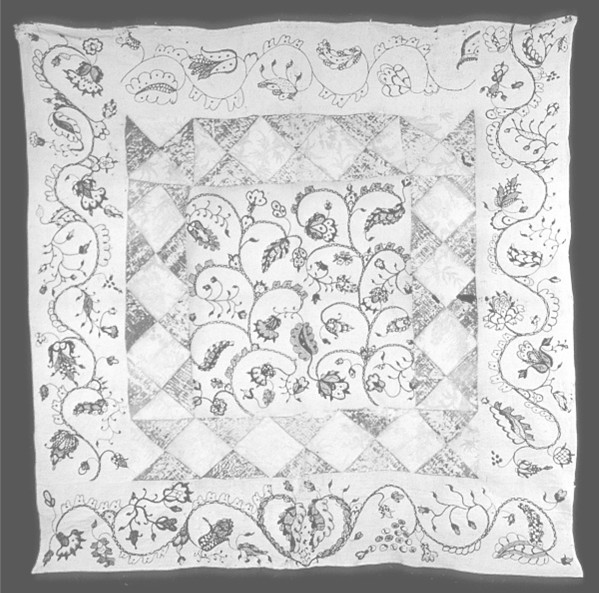
Martha’s 1792 quilt courtesy of the Smithsonian Institute https://americanhistory.si.edu/collections/object/nmah_556358